Icedout AI Virtual Try-On Case Study: €15.3K in Attributed Revenue

What you will learn
- August at a glance
- The challenge: jewelry is personal
- How Icedout uses Tryvio
- From try-ons to real orders
- How Tryvio attribution works
- What about the estimated +8.1-point conversion lift?
- Why virtual try-on fits Icedout
- What other fashion brands can take from the result
- 1. Start where visual uncertainty is highest
- 2. Put try-on at the decision point
- 3. Measure purchases, not generations alone
- The takeaway
Virtual try-on can generate engagement. For an ecommerce brand, though, the more important question is whether that engagement appears in real purchasing journeys.
For Icedout, the answer during August was measurable.
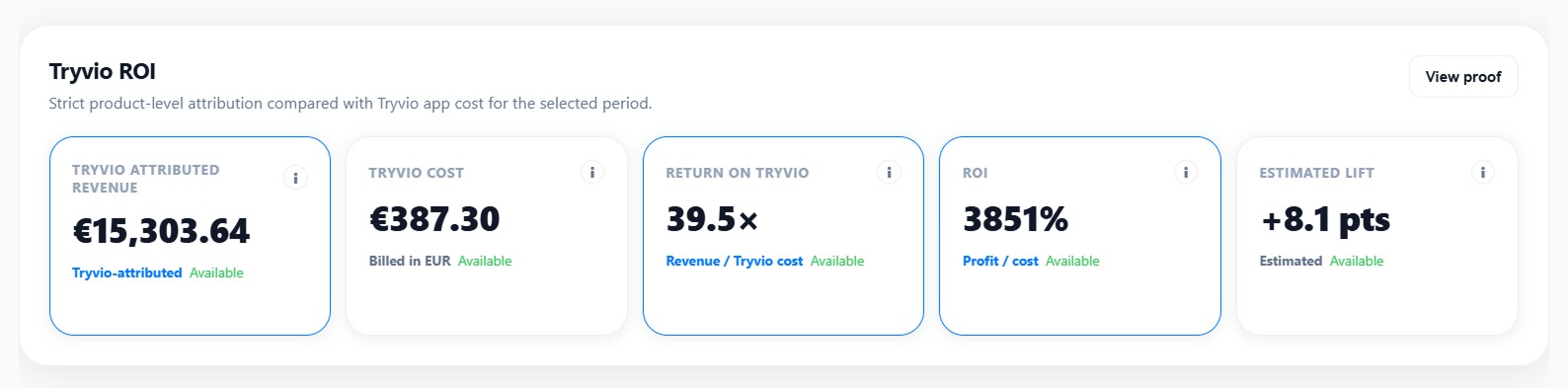
Customers generated 623 billable virtual try-ons through Tryvio, connected to €15,303.64 in Tryvio-attributed revenue. Tryvio cost €387.30 during the same period.
That equals a 39.5× revenue-to-Tryvio-cost return.
August at a glance
| Metric | August result |
|---|---|
| Virtual try-ons | 623 |
| Tryvio-attributed revenue | €15,303.64 |
| Tryvio cost | €387.30 |
| Revenue-to-cost return | 39.5× |
| Estimated conversion lift | +8.1 percentage points |
The reporting period covers August 1–31.
The strongest comparison is straightforward:
€15,303.64 ÷ €387.30 = 39.5×
For every €1 spent on Tryvio during the period, €39.50 in revenue was attributed to qualifying Tryvio interactions.
That does not mean all €15,303.64 was incremental revenue or that €39.50 was profit. We explain the attribution and limitations in more detail below.
The challenge: jewelry is personal
Icedout is a Bulgarian fashion-accessories brand selling necklaces, bracelets, rings, watches, sunglasses and other highly visual products.
Product photography can show the design, finish and detail of an item.
What it cannot completely answer is how that item will look on a particular shopper.
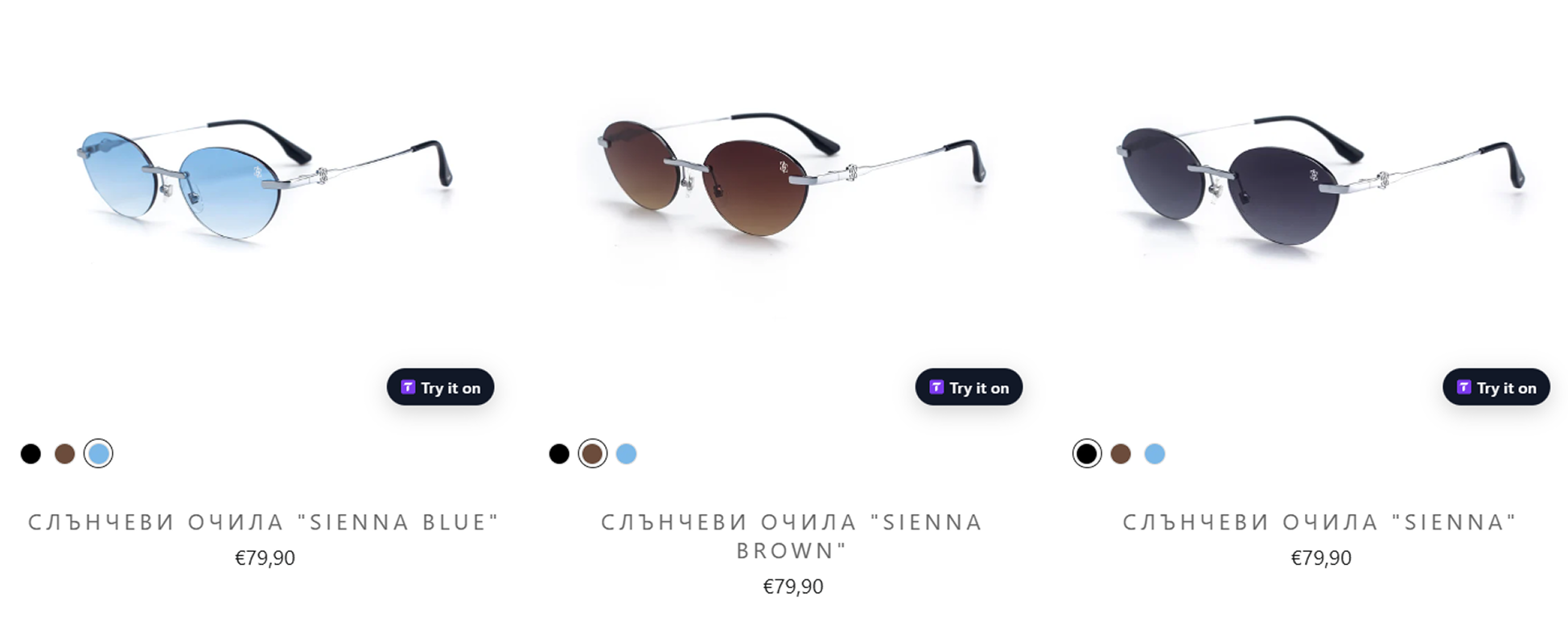
A necklace can look balanced on a model while leaving someone unsure about its scale on their own body. A pair of sunglasses can look great in a campaign image without answering whether the frame suits the shopper's face. The same uncertainty applies to watches, bracelets and rings.
That creates friction at exactly the point where interest needs to become a decision.
Tryvio was added to Icedout's product pages and collection pages to give shoppers another way to evaluate the product: see it on themselves before ordering.
How Icedout uses Tryvio
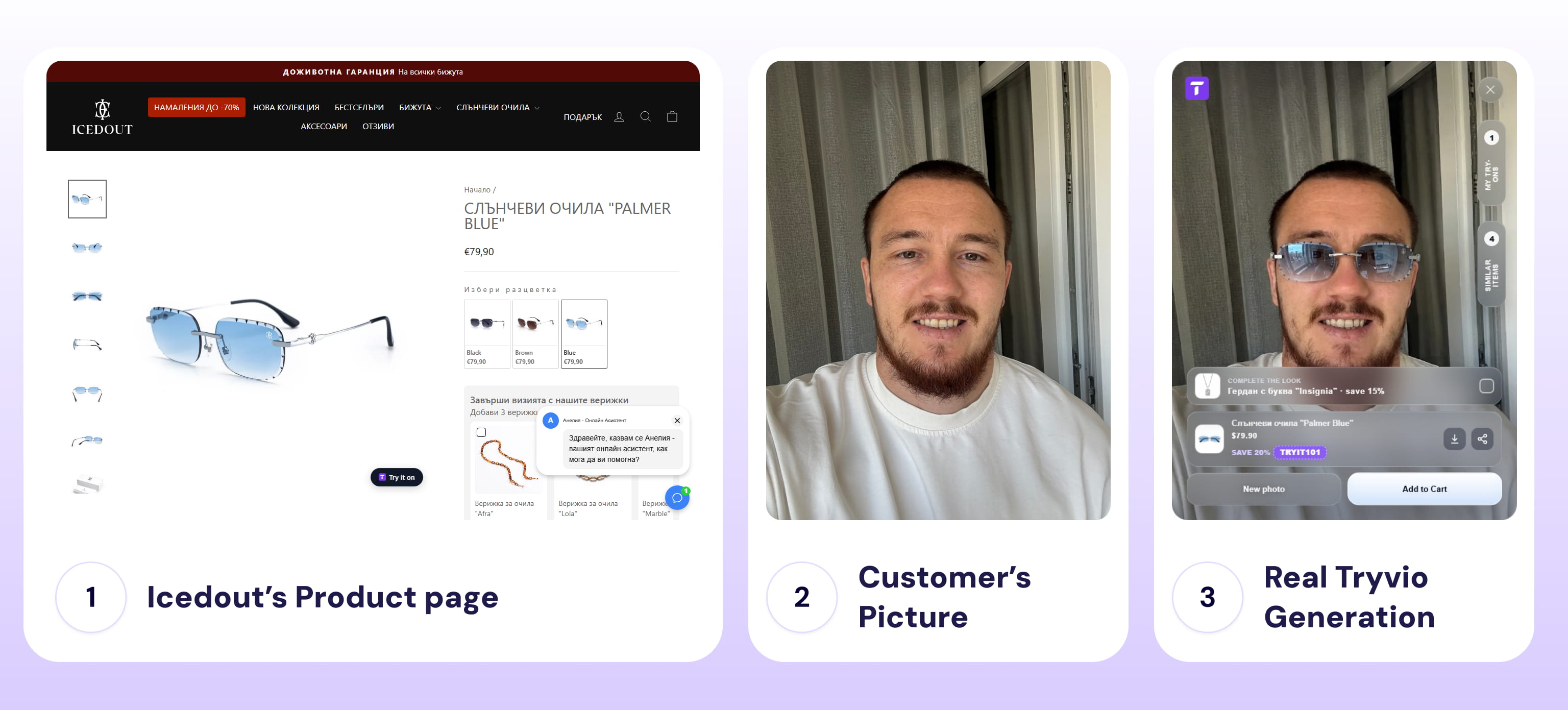
The experience happens directly inside the Shopify store.
A shopper:
- Opens an Icedout product page.
- Selects Try It On.
- Uploads or chooses a photo.
- Receives a personalized visualization with the selected product.
- Continues shopping without leaving the store.
There is no separate consumer app and no need to move the shopper away from the product page.
The important part for Icedout is that Tryvio does not stop at counting generated images. Qualifying purchases are connected back to try-on activity at product level, allowing the merchant to evaluate the feature against actual revenue.
From try-ons to real orders
623 generations tell us that shoppers used the feature.
On their own, however, generations are only an engagement metric.
The more commercially relevant result is the €15,303.64 in qualifying revenue attributed to Tryvio interactions during the month.
That makes it possible to evaluate virtual try-on as part of the ecommerce experience rather than simply as an AI feature generating images.
Icedout has also shared its experience publicly on the Shopify App Store:
"This app boosted the conversion rate of our website with almost 35%, going from avarage of 1.7-2% to around 2.6-3% depending on different day, mostly coming from abandoned carts, probably because people could see how they look with the items before ordering. The Klaviyo integration itself is great too, overall very happy with the app, would recommend for jewelry, sunglasses and clothing for sure."
— Icedout, Shopify App Store review
How Tryvio attribution works
Tryvio tracks virtual try-on activity at product level and connects qualifying orders back to products shoppers interacted with.
Simply opening the Tryvio experience does not automatically cause every subsequent order to appear as Tryvio-attributed revenue.
For revenue to qualify, the purchased product needs to meet Tryvio's product-level attribution rules.
This distinction matters.
Attributed revenue is not the same as guaranteed incremental revenue.
The August data tells us that €15,303.64 in qualifying orders was connected to Tryvio-supported shopping journeys. It cannot tell us with certainty that every one of those orders would have been lost without virtual try-on.
Similarly, the 39.5× figure is a software-cost return, not Icedout's accounting profit. It does not subtract merchandise cost, advertising, fulfilment, taxes, returns or other operating expenses.
What about the estimated +8.1-point conversion lift?
Tryvio's dashboard also estimated a +8.1 percentage-point conversion lift during the selected period.
We treat this as a secondary, directional metric rather than the headline result.
It represents the difference associated with Tryvio-supported shopping behaviour against the relevant dashboard baseline. It is not the result of a controlled randomized A/B test, so it should not be interpreted as proof that Tryvio independently caused an 8.1-point increase.
Traffic quality, product mix, pricing, promotions, imagery and customer intent can all influence conversion.
That is why we consider the revenue attribution and cost comparison the more useful result in this case study.
Why virtual try-on fits Icedout
Icedout operates in categories where appearance is part of the buying decision.
For a necklace, the shopper may care about length and visual presence.
For a watch or bracelet, proportion on the wrist matters.
For sunglasses, the product interacts directly with the shopper's face.
Virtual try-on does not replace accurate product photography, dimensions or product information.
It answers a different question:
“Can I picture myself wearing this?”
For Icedout, enough shoppers chose to answer that question through Tryvio that the interaction became a measurable part of the purchase journey.
What other fashion brands can take from the result
1. Start where visual uncertainty is highest
Virtual try-on is most useful when seeing the product in personal context can genuinely help the shopper decide.
That applies beyond jewelry to categories including apparel, eyewear, footwear, watches and accessories.
2. Put try-on at the decision point
Icedout customers do not need to visit a separate experience.
Virtual try-on sits directly on the product page, where shoppers are already evaluating a specific item.
The fewer steps between interest and visualization, the more naturally the feature fits into the buying journey.
3. Measure purchases, not generations alone
A large number of generated images can look impressive.
It does not necessarily tell a merchant whether the feature is commercially useful.
Try-on volume, qualifying orders, attributed revenue and cost should be evaluated together.
That is what turns virtual try-on from an engagement feature into something a merchant can measure.
The takeaway
For Icedout, August produced:
623 virtual try-ons.
€15,303.64 in Tryvio-attributed revenue.
€387.30 in Tryvio cost.
39.5× revenue-to-cost return.
The result is specific to Icedout and this reporting period. It does not guarantee that another store will reproduce the same numbers.
What it does demonstrate is that virtual try-on can sit directly inside the shopping journey of a highly visual product category — and that its impact can be measured beyond the number of images generated.
If you want to see how Tryvio performs with your own products, you can install Tryvio from the Shopify App Store or book a demo with our team.
Frequently asked questions
What is Tryvio-attributed revenue?
Tryvio-attributed revenue is revenue from qualifying orders connected to products shoppers interacted with through Tryvio, according to its product-level attribution rules. It should not be interpreted as guaranteed incremental revenue.
How is the 39.5× return calculated?
The figure compares Tryvio-attributed revenue with Tryvio cost during the same reporting period: €15,303.64 ÷ €387.30 = 39.5× It is a software-cost return metric, not Icedout's overall profit margin.
Is the +8.1-point conversion lift an A/B test result?
No. The figure is an estimate generated by the Tryvio dashboard for the selected period. It is directional evidence, not the result of a controlled randomized experiment, and should not be treated as a guaranteed conversion increase.

Related posts



Tryvio adds AI virtual try-on to your Shopify product pages — installed in minutes, measured on your dashboard.
Install Tryvio →