What High-Intent Shopping Behavior Looks Like in Fashion Ecommerce
What you will learn
- What is high-intent shopping behavior?
- 1. Returning to the same product
- 2. Selecting a size, color or variant
- 3. Reading reviews and product details
- 4. Saving, favoriting or wishlisting a product
- 5. Virtually trying on a product
- 6. Adding to cart
- Not all intent signals should be treated equally
- Use intent to make follow-up more relevant
- Intent signals can also reveal CRO problems
- Don't optimize for interactions alone
- The takeaway
Not every product-page visit means the same thing.
One shopper may land on a product, scroll for five seconds and leave.
Another may choose a size, read reviews, compare colors, return later and try the product on virtually.
Both technically viewed the same product.
But their level of intent is completely different.
For fashion ecommerce brands, understanding that difference can lead to better segmentation, more relevant follow-up and smarter decisions about where to focus CRO efforts.
What is high-intent shopping behavior?
High-intent behavior is any action that suggests a shopper is moving beyond casual browsing and actively evaluating whether to buy.
A product view alone tells you someone was interested enough to open the page.
Additional actions tell you much more.
The important question is not simply:
“Did they visit the product page?”
It is:
“What did they do once they got there?”
1. Returning to the same product
A shopper who visits the same product several times is behaving differently from someone who sees it once.
Repeat views can suggest that they are:
- Comparing the product with alternatives
- Waiting before making a decision
- Checking availability again
- Returning after seeing the product elsewhere
- Moving closer to purchase
That does not guarantee a sale.
But repeated interest is usually more meaningful than a single impression.
This is one reason ecommerce teams should avoid treating every PDP visitor as part of one identical audience.
2. Selecting a size, color or variant
Choosing a variant is a small action, but it often means the shopper has started imagining the purchase more concretely.
There is a difference between:
“I like this dress.”
and:
“Would I buy this dress in M and black?”
The second question is much closer to an actual buying decision.
Variant interaction can therefore be useful context when analysing product-page behavior, especially in categories where sizing, color or style choice creates friction.
3. Reading reviews and product details
Shoppers usually look for more information when they still have a question to resolve.
That could mean opening:
- Reviews
- Size guides
- Material information
- Shipping details
- Returns information
- Product specifications
These interactions do not necessarily indicate stronger purchase intent on their own.
But they can reveal what is standing between interest and purchase.
If a large number of shoppers repeatedly open the size guide and then leave, for example, the problem may not be traffic.
It may be uncertainty.
That is one reason we often think of CRO as reducing unanswered questions rather than simply adding more persuasion.
4. Saving, favoriting or wishlisting a product
A wishlist is an obvious example of deferred intent.
The shopper is effectively saying:
“Not now, but don't let me lose this.”
That makes saved products particularly useful for follow-up.
Instead of generic remarketing based on pages someone happened to visit, brands can reconnect around products the shopper actively chose to remember.
The purchase journey does not always happen in one session.
Sometimes the most valuable signal is that someone wants to continue it later.
5. Virtually trying on a product
Virtual try-on adds another level of engagement.
There is a meaningful difference between:
Viewing a product
and:
Uploading or selecting a photo to see that product on yourself.
The second action requires more effort and makes the experience personal.
The shopper is no longer evaluating only the product.
They are evaluating the product in relation to themselves.
That makes virtual try-on useful not only as a visualization tool, but also as an intent signal.
With Tryvio, that interaction can remain useful even when the shopper does not purchase immediately.
Try-on activity can become part of the follow-up journey, giving brands context around the products a shopper actively visualized rather than simply viewed.
This is especially relevant when connected with email and lifecycle marketing. We explored that idea further in our guide to turning virtual try-on activity into smarter customer follow-up.
6. Adding to cart
Add to cart remains one of the clearest high-intent actions in ecommerce.
At this stage, the shopper has moved from evaluating the product to actively preparing to purchase it.
But even cart activity should be viewed in context.
A shopper may:
- Add several sizes while comparing
- Add products to calculate shipping
- Save the cart for later
- Abandon because of delivery costs
- Get distracted before completing checkout
The cart is therefore not the end of the intent journey.
It is another strong signal within it.
Not all intent signals should be treated equally
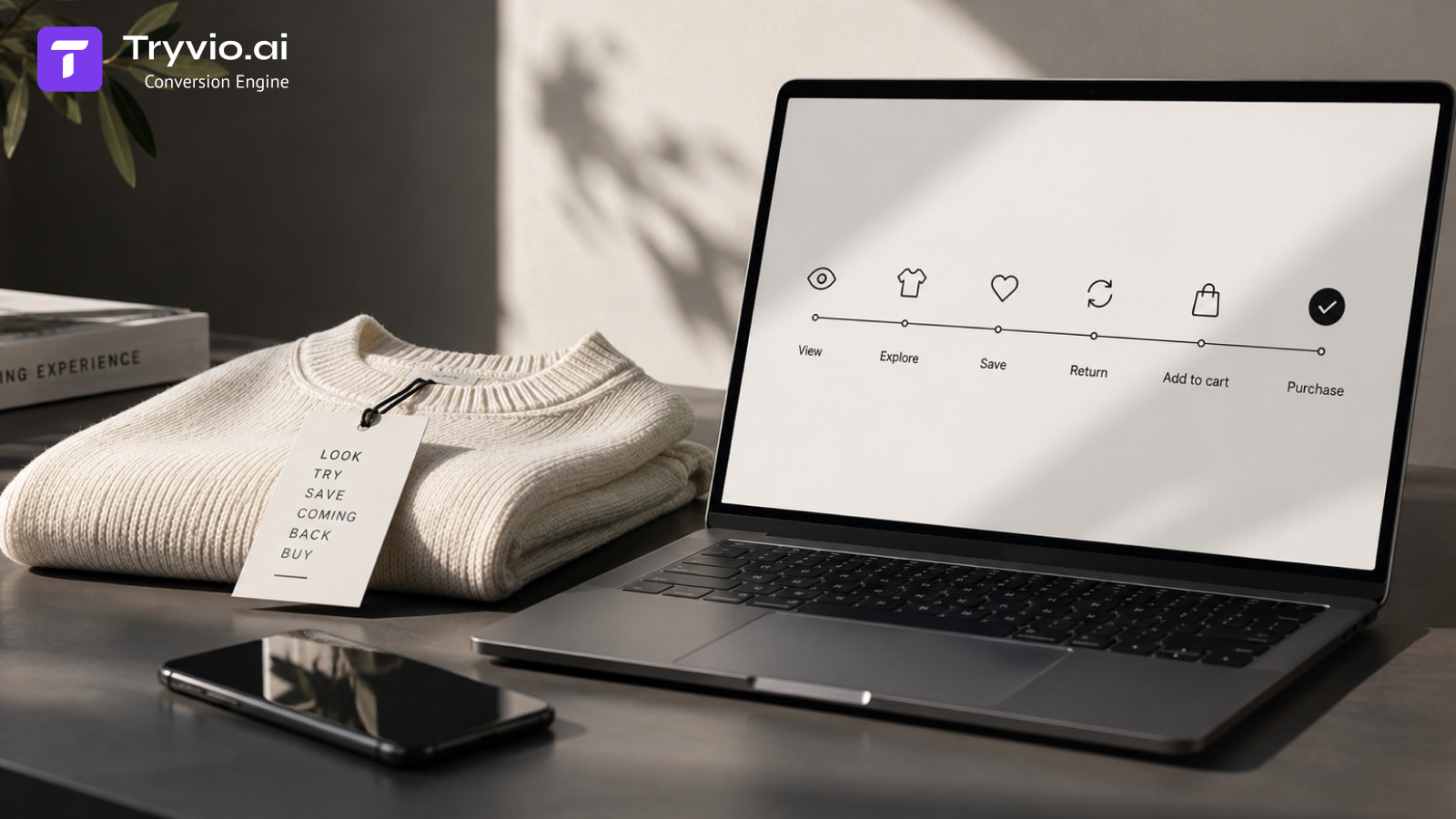
A useful way to think about ecommerce behavior is as a progression.
For example:
Product view
↓
Variant selection
↓
Review / size-guide interaction
↓
Wishlist or virtual try-on
↓
Add to cart
↓
Checkout
This is not a universal funnel.
Shoppers move backwards, skip stages and behave differently depending on the product.
But the principle is important:
The more effort and personal context an interaction requires, the more information it can reveal about shopper intent.
That is why a simple page view should not automatically be treated the same way as someone who has actively configured, saved or visualized a product.
Use intent to make follow-up more relevant
Once brands start distinguishing between different levels of intent, follow-up can become much more useful.
Instead of sending the same message to everyone who viewed a product, you can think about different experiences for:
- Someone who viewed it once
- Someone who returned three times
- Someone who selected a size
- Someone who saved it
- Someone who virtually tried it on
- Someone who added it to cart
The goal is not to create dozens of complicated automations.
It is to use the context you already have.
A shopper who tried on a particular jacket, for example, can receive a very different message from someone who briefly landed on the same PDP.
“You viewed this product” is generic.
“Here is another look at the product you tried on” starts from a much more personal place.
Intent signals can also reveal CRO problems
High-intent behavior is not only useful for remarketing.
It can also tell you where shoppers are getting stuck.
If people repeatedly:
- Select a size but do not add to cart
- Read return information before leaving
- Try products on but do not continue
- Add to cart but abandon at shipping
- Return to the same PDP several times without buying
there may be a specific question that your shopping experience is failing to answer.
That makes behavioral intent valuable for both marketing and CRO.
The goal is not just to identify who is likely to buy.
It is also to understand what is preventing them from buying now.
This connects closely with another issue we have explored before: fashion returns often begin before checkout, when shoppers do not have enough information or confidence to choose correctly.
Don't optimize for interactions alone
There is one important caution.
More engagement does not automatically mean better ecommerce performance.
A shopper clicking six different tools because the product page is confusing is not necessarily a success.
That is why intent signals should eventually be connected to commercial outcomes such as:
- Add-to-cart rate
- Checkout progression
- Conversion
- Revenue
- Repeat purchase behavior
Try-on generations are a good example.
The number of generations tells you whether shoppers are using the feature.
But the more important question is whether those interactions appear in actual purchasing journeys.
In our Icedout virtual try-on case study, we looked at exactly that distinction – measuring try-on activity alongside attributed orders and revenue rather than treating generations as the final KPI.
The takeaway
Fashion ecommerce generates far more behavioral data than simple page views.
The challenge is deciding which interactions actually matter.
A shopper who selects a size, returns to the same product, saves it, reads reviews or tries it on is telling you something about their decision process.
Each signal provides a little more context.
And that context can help brands create:
- Better product pages
- More relevant follow-up
- Smarter segmentation
- More useful personalization
The goal is not to track every possible click.
It is to recognize when a shopper is moving from browsing to considering – and respond accordingly.
Frequently asked questions
What is high-intent behavior in ecommerce?
High-intent behavior refers to actions that suggest a shopper is actively considering a purchase rather than casually browsing. Examples can include repeat product views, variant selection, wishlisting, virtual try-on, adding to cart and beginning checkout.
Is a product view considered high intent?
A product view shows interest, but on its own it is usually a relatively weak intent signal. Additional actions such as choosing a size, returning to the product, saving it or adding it to cart provide more context about how seriously the shopper is considering the purchase.
Why is virtual try-on a useful intent signal?
Virtual try-on requires the shopper to actively personalize the product experience by visualizing the item on themselves. That additional effort can provide more context than a standard product view, while also helping the shopper evaluate appearance before buying.
How can Shopify brands use intent data?
Brands can use shopper-intent signals to improve segmentation, personalize follow-up, identify product-page friction and analyse which interactions are associated with progression toward purchase.

Related posts

Tryvio adds AI virtual try-on to your Shopify product pages — installed in minutes, measured on your dashboard.
Install Tryvio →