Your Fashion Store Doesn’t Have a Traffic Problem – It Has a Confidence Problem

What you will learn
- Traffic problems and conversion problems are not the same
- Diagnose where shoppers are getting stuck
- Where confidence usually breaks in fashion ecommerce
- Fit and sizing
- Appearance
- Product understanding
- Expectation and trust
- Purchase risk
- Don't solve uncertainty with more persuasion
- Match the solution to the uncertainty
- Fix the experience before scaling the audience
- Measure whether confidence actually improved
- The takeaway
When growth slows, buying more traffic feels like the obvious answer.
More ads.
More creators.
More SEO.
More visitors.
Sometimes that is exactly what a store needs.
But if qualified shoppers are already reaching your product pages, exploring products and showing signs of purchase intent, sending more people into the same experience may simply create more of the same outcome.
The real issue may be purchase confidence.
A shopper can like the product and still hesitate:
Will it fit?
Will it look the same in real life?
Will I actually like it on me?
What happens if I get it wrong?
Before increasing acquisition spend, it is worth asking a different question:
Is traffic actually the bottleneck?
Traffic problems and conversion problems are not the same
Traffic determines how many opportunities your store creates.
Conversion determines what happens to those opportunities.
Imagine two fashion stores receiving similar qualified traffic.
Store A gives shoppers clear sizing, useful product details, realistic imagery, relevant reviews and transparent delivery information.
Store B leaves several of those questions unanswered.
Sending another 10,000 visitors to Store B may still increase revenue through volume.
But it also sends another 10,000 people into the same uncertainty.
That is why weak fashion ecommerce conversion should not automatically be treated as an acquisition problem.
First ask:
Are the right people reaching the store?
Then:
What happens after they arrive?
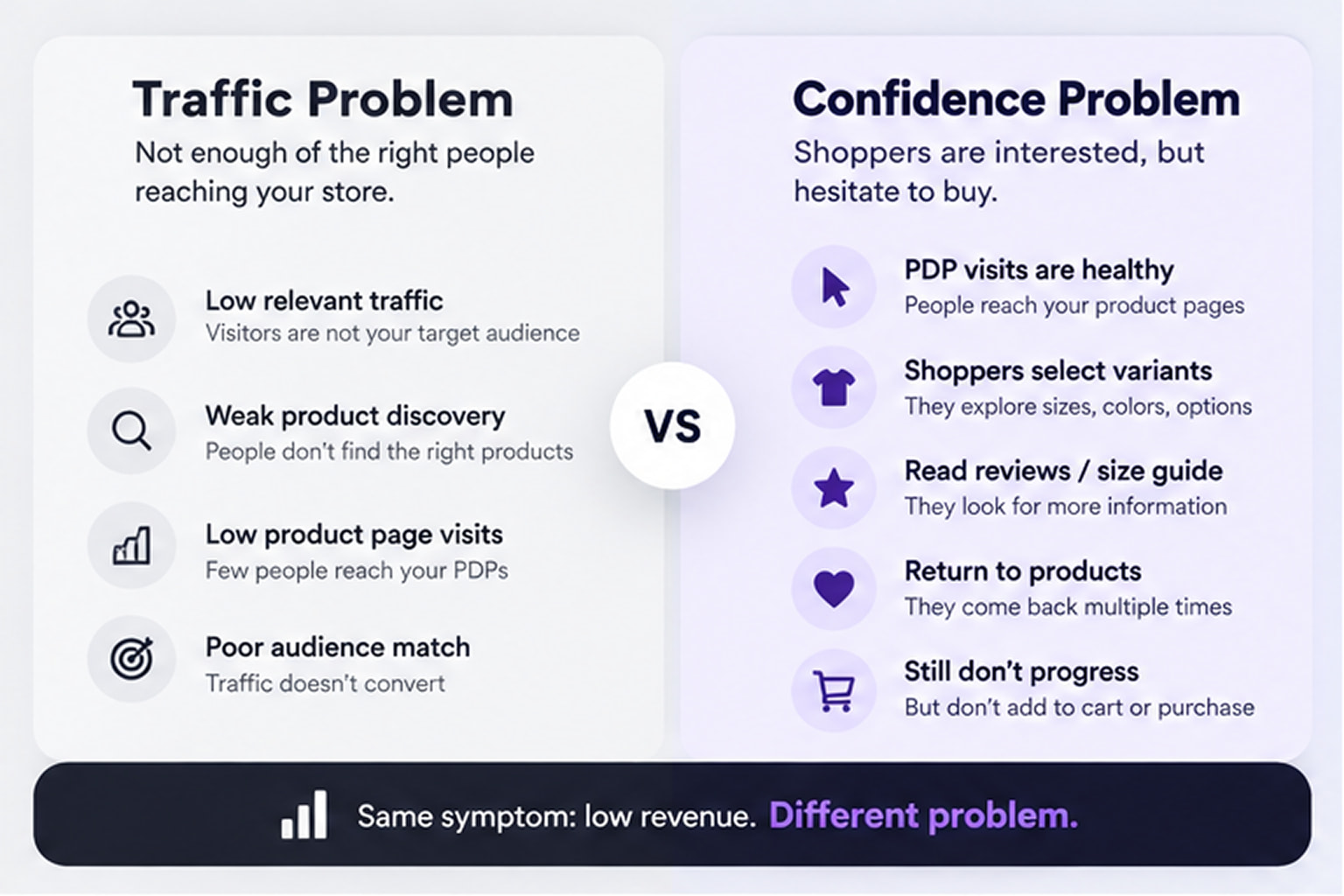
Diagnose where shoppers are getting stuck
You cannot understand the problem from overall conversion rate alone.
Look at how shoppers progress through the store.
| What you see | What it may suggest |
|---|---|
| Low product-page engagement | Traffic or merchandising mismatch |
| Product views but little variant interaction | Weak interest or unclear product proposition |
| Size selection but low add-to-cart | Fit, price or confidence friction |
| Repeat PDP visits without purchase | Ongoing consideration or unanswered questions |
| Heavy size-guide / review usage | Information shoppers are trying to resolve |
| Strong add-to-cart but weak checkout progression | Shipping, price or cart friction |
| Checkout starts but few purchases | Payment, delivery or checkout friction |
These are not universal rules.
A shopper opening a size guide may be highly interested—or simply confused.
The goal is to identify patterns, not assign a fixed meaning to every click.
We explored these signals in more detail in What High-Intent Shopping Behavior Looks Like in Fashion Ecommerce.
Where confidence usually breaks in fashion ecommerce
Once the data points toward a product-decision problem, the next step is identifying what the shopper is uncertain about.
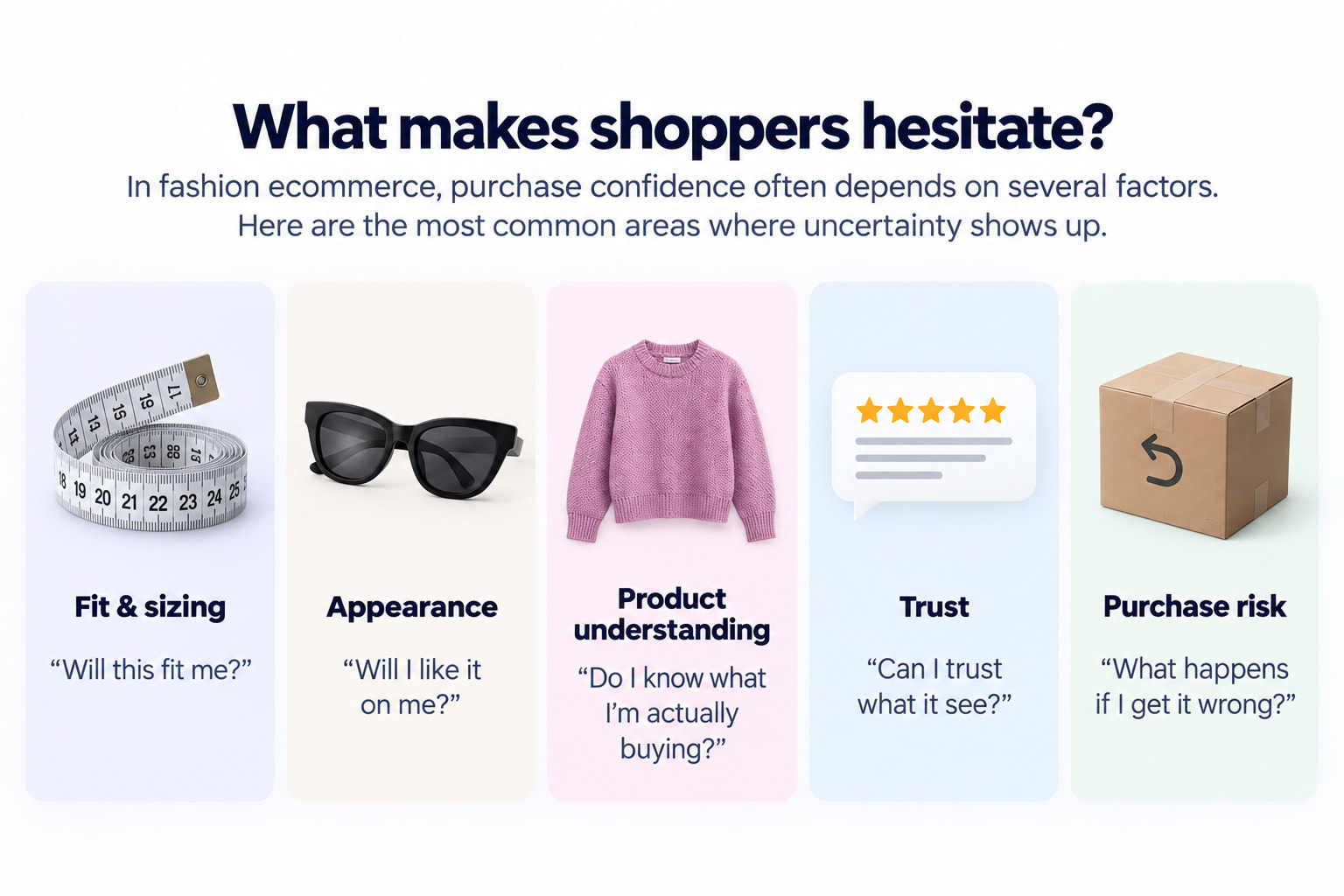
Fit and sizing
The shopper likes the product but is unsure which version to order.
That may come from:
- Inconsistent sizing
- Poor fit guidance
- Missing model measurements
- Difficult-to-use size charts
- Conflicting customer reviews
Appearance
The shopper understands the product but cannot confidently imagine the outcome.
Traditional product content can show:
- Styling
- Material
- Detail
- Movement
- Scale
But it cannot show every individual shopper exactly how the product might look on them.
Baymard’s apparel ecommerce research found that shoppers who do not feel confident about a product’s appearance, size or fit may abandon the site.
Product understanding
Sometimes the information exists, but the shopper still has to guess.
Fashion PDPs should make important details easy to understand:
- Material
- Fit
- Length
- Measurements
- Stretch
- Care
- Color
- Product scale
Marketing language such as “premium quality” or “timeless design” cannot replace practical buying information.
For a deeper breakdown of product-page friction, see Why Fashion Shoppers Abandon Product Pages.
Expectation and trust
Highly polished imagery can sell the aesthetic while still leaving practical questions unanswered.
Shoppers may want to know:
- Is the color accurate?
- How does it look outside a studio?
- What do other customers say about fit?
- Does the material look different in natural light?
Customer photos, useful reviews and accurate imagery can reduce the gap between the product page and reality.
Purchase risk
Even when the product itself looks right, the shopper may hesitate because of what happens afterward.
Questions such as:
- How long will delivery take?
- What will shipping cost?
- Can I return it?
- How long is the return window?
- Who pays for the return?
all affect how risky the decision feels.
Clear policies do not necessarily persuade someone to buy.
They remove another reason not to.
Don't solve uncertainty with more persuasion
When conversion is weak, ecommerce teams often add something.
Another urgency message.
Another sticky button.
Another discount.
Another popup.
Another social-proof widget.
Sometimes those tactics help.
But if shoppers are missing information, adding more persuasion does not answer their question.
Before asking:
“How can we push this shopper harder?”
ask:
“What do they still need to know?”
That leads to more useful CRO questions:
- Is sizing understandable?
- Are important product details visible?
- Do images show enough context?
- Are reviews answering real objections?
- Are delivery and returns easy to find?
- Can shoppers evaluate how the product relates to them?
The best conversion improvement may be removing a question rather than adding another sales message.
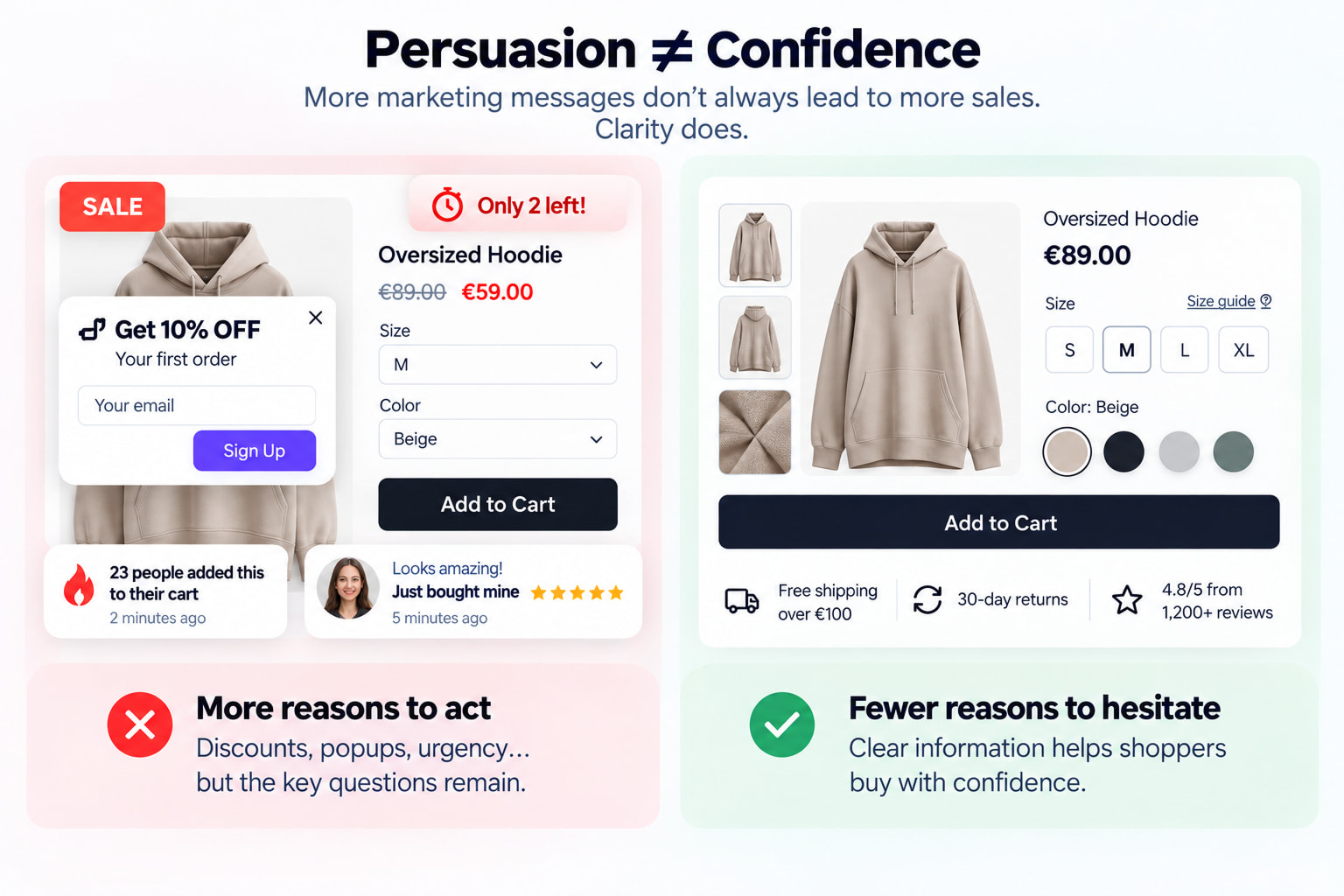
Match the solution to the uncertainty
Different confidence problems need different tools.
Sizing uncertainty
→ Better size guidance and fit information
Quality uncertainty
→ Better photography, video and material detail
Social uncertainty
→ Reviews and customer-generated content
Purchase-risk uncertainty
→ Clear shipping, exchanges and returns
Visual uncertainty
→ More personalized ways to evaluate appearance
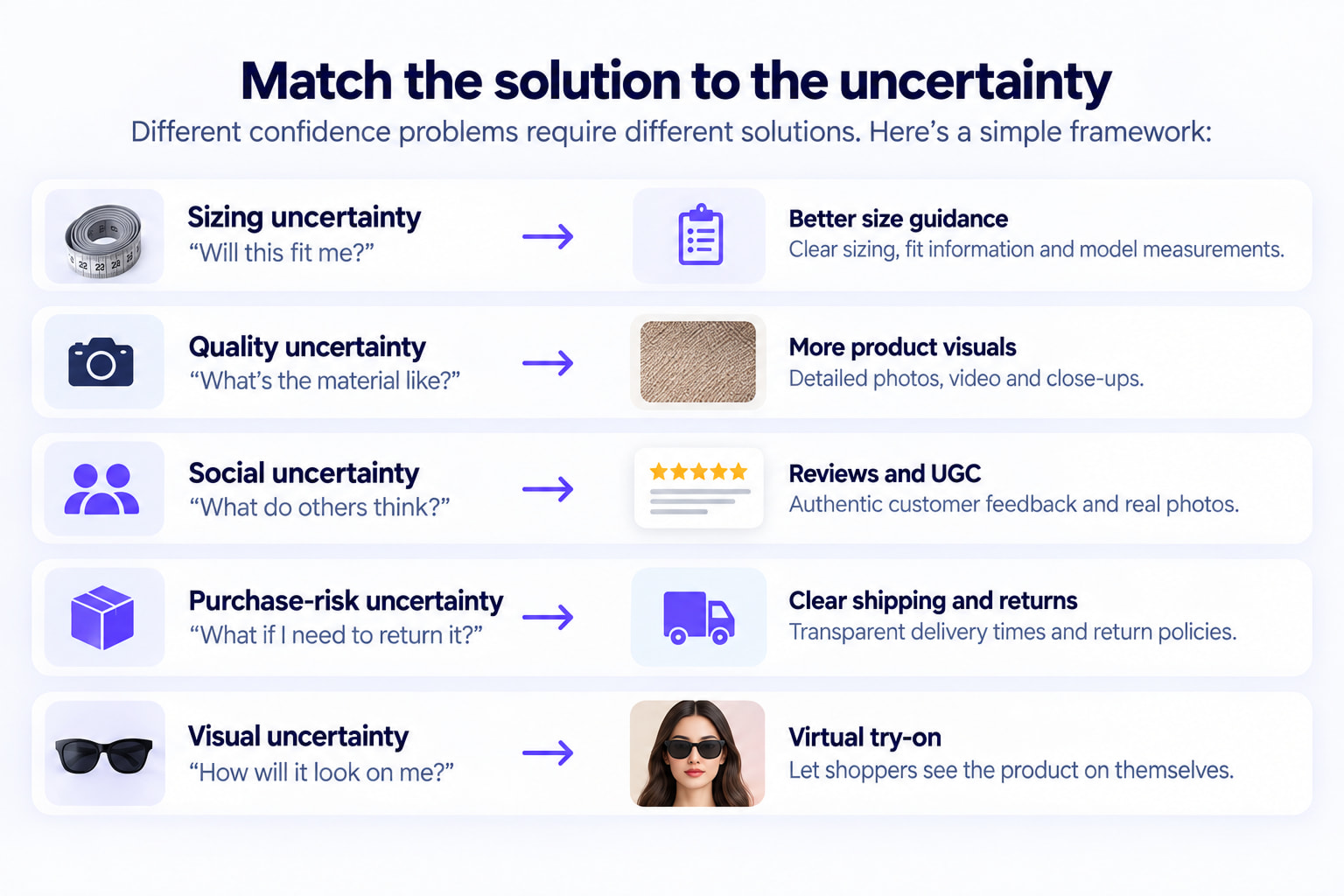
This last category is where virtual try-on can help.
With Tryvio, shoppers can visualize fashion products on themselves directly from the product page instead of relying entirely on model photography.
That does not replace strong product content.
It answers a different question:
“What might this look like on me?”
In the Icedout AI virtual try-on case study, shoppers completed 623 virtual try-ons during August, connected to €15.3K in qualifying Tryvio-attributed revenue.
The useful lesson is not that every store needs the same tool.
It is that the solution should match the uncertainty preventing the decision.
Fix the experience before scaling the audience
Traffic still matters.
But sequencing matters too.
If qualified visitors already:
- Reach your PDPs
- Return to products
- Select variants
- Read reviews
- Save products
- Try products on
- Add products to cart
yet consistently stop before purchasing, more acquisition may not be the highest-leverage next move.
Understand where the journey breaks first.
Then improve it.
After that, every additional visitor enters a stronger store.
Measure whether confidence actually improved
Purchase confidence itself is difficult to measure directly.
Behavior is easier.
After making a change, watch metrics such as:
- PDP-to-cart rate
- Variant-selection behavior
- Size-guide usage
- Repeat product visits
- Wishlist activity
- Virtual try-on usage
- Checkout progression
- Conversion
- Return reasons
Do not interpret one metric alone.
For example, fewer size-guide opens could mean sizing became clearer.
Or it could mean shoppers stopped noticing the guide.
Look for multiple signals moving together.
The objective is not simply to generate more interaction.
It is to help more shoppers make a confident and accurate purchase decision.
The takeaway
Sometimes a fashion store genuinely needs more traffic.
But sometimes the traffic is already there.
Shoppers reach the product.
They interact with it.
They return.
They consider buying.
And then they stop.
When that happens, the better question may not be:
“How do we get more people onto this page?”
It may be:
“What is making the people already here hesitate?”
Better sizing, clearer information, realistic imagery, useful reviews, transparent policies and personalized product experiences all solve different parts of that problem.
More traffic can amplify a strong shopping experience.
It cannot fix an uncertain one.
Frequently asked questions
What is purchase confidence in fashion ecommerce?
Purchase confidence is the shopper’s level of certainty that a product is right for them and that the purchase will meet their expectations. In fashion, this can include fit, sizing, appearance, product quality, delivery and return conditions.
How can fashion brands identify purchase uncertainty?
Look beyond overall conversion rate. Behaviors such as repeated product visits, frequent size-guide use, variant selection without cart activity, review engagement, wishlisting, and cart abandonment can provide clues about where shoppers are hesitating.
Can better product pages improve fashion ecommerce conversion?
Product pages cannot solve every conversion problem, but clearer product information, imagery, sizing, reviews, and policies can remove avoidable uncertainty. The goal is to help shoppers evaluate products accurately rather than simply adding more persuasion.
How does virtual try-on help shopper confidence?
Virtual try-on helps shoppers evaluate how a product may look in relation to themselves rather than relying entirely on standard product photography. It addresses visual uncertainty, particularly for apparel, eyewear, jewelry, watches, and accessories.
Should a store improve CRO before increasing traffic?
It depends on the situation. If qualified shoppers already reach product pages but repeatedly hesitate before purchasing, improving the shopping experience may create more value than increasing acquisition spend.
How can I tell whether my store has a traffic problem or a conversion problem?
Start by looking at traffic quality and what visitors do after arriving. If relevant shoppers reach product pages but rarely engage, acquisition or merchandising may be the issue. If they interact deeply with products but repeatedly stop before purchase, product confidence or downstream friction may deserve more attention.

Related posts


Tryvio adds AI virtual try-on to your Shopify product pages — installed in minutes, measured on your dashboard.
Install Tryvio →